
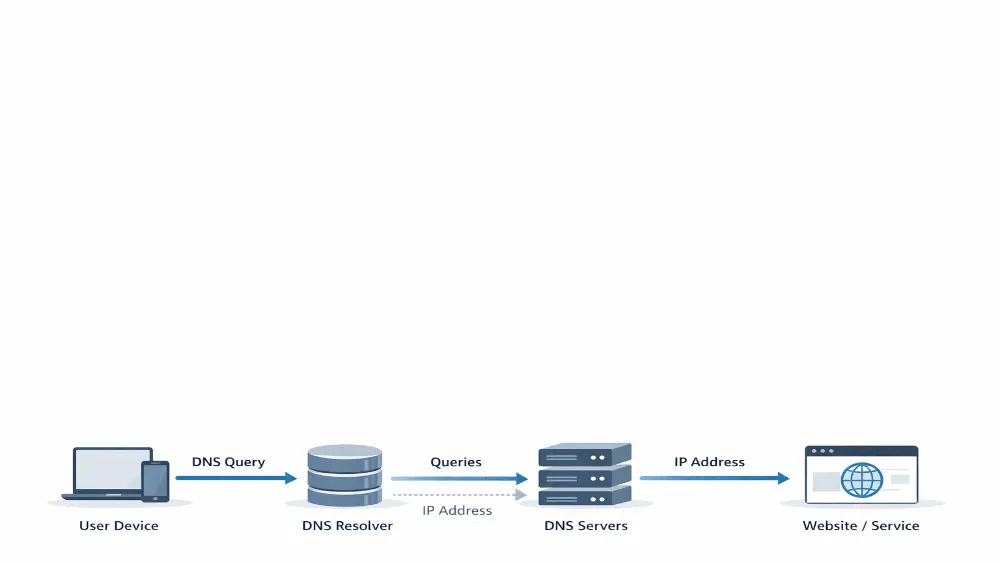
The Domain Name System (DNS) is one of the Internet’s most basic building blocks. In simple terms, DNS helps devices find websites and online services by translating human-readable names into network locations.
Every time an application connects to a service, a DNS request is made quietly in the background. These requests happen constantly, across every region, platform, and digital experience.
What makes DNS especially interesting is not the technology itself, but the data it produces. DNS data reflects real-time digital behavior: which services are being accessed, how frequently systems interact, and how online activity changes over time.
Because DNS sits at the starting point of almost every internet interaction, it provides a broad, unbiased view of how the digital world actually operates.
Despite this, DNS data is often overlooked as an intelligence source. It is usually treated as technical plumbing—useful for keeping networks running, but not for deeper analysis. Raw DNS logs can appear noisy and difficult to interpret, which leads many organizations to ignore their broader value.
When properly collected, enriched, and analyzed, DNS data becomes more than operational metadata. It becomes a powerful signal that can inform understanding, reveal patterns, and support better decision-making across modern digital systems. If you’re new to the concept, we first recommend reading our introduction to DNS Intelligence and why it matters before diving into the data pipeline.
What Raw DNS Data Really Is (and Isn’t)
Raw DNS data is the direct output generated when devices and applications attempt to connect to online services. At a basic level, it includes domain name queries, timestamps showing when those requests occurred, and information about how DNS resolvers handled those requests. Each record represents a single moment of interaction, captured without interpretation or explanation.
On its own, this data is purely descriptive. It tells us that a request happened, not why it happened or what it means. A large network can generate millions of DNS queries in a short time, creating an overwhelming stream of records.
Many of these entries are repetitive, automated, or routine, which makes the data appear noisy and difficult to work with.
Another key limitation of raw DNS data is the lack of context. A domain name alone does not explain the purpose of the service behind it, how it relates to other domains, or whether its behavior is expected or unusual. Without additional information, individual DNS records remain isolated events.
This is where the distinction between data and intelligence becomes clear. Raw DNS data is a collection of facts. Intelligence emerges only when those facts are organized, enriched with context, and analyzed for patterns and meaning.
Until that transformation happens, DNS data remains information, not insight. This article explains how raw DNS data is transformed into intelligence, and why that transformation matters beyond traditional network operations.
The DNS Intelligence Pipeline: From Data to Insight
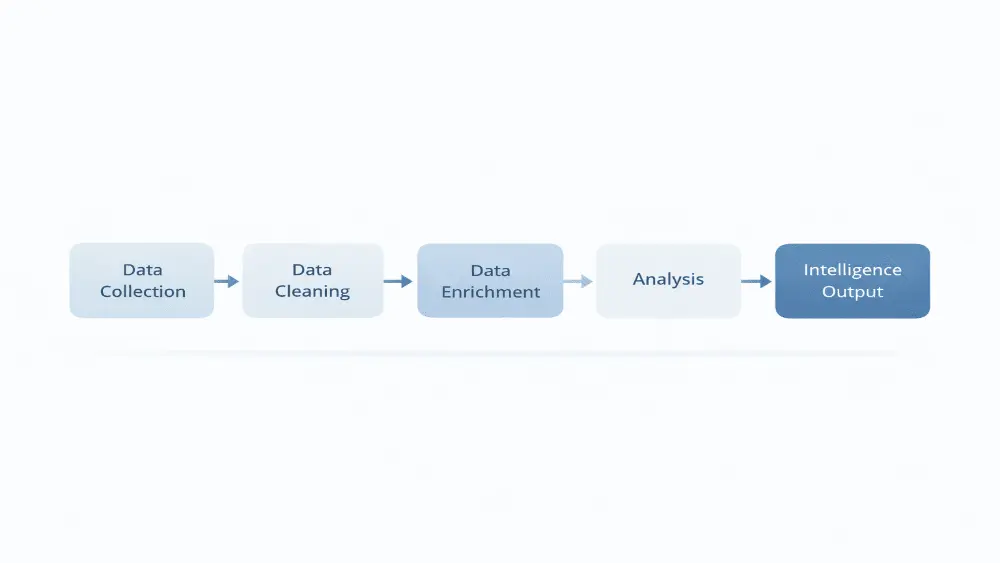
Transforming DNS data into meaningful intelligence requires a structured pipeline. Each stage in this process plays a specific role in turning raw records into insights that can support informed decisions. Without this progression, DNS data remains fragmented and difficult to interpret.
The pipeline begins with data collection. DNS data must be gathered consistently and at sufficient scale to reflect real-world activity. Incomplete or inconsistent collection limits visibility and reduces the reliability of any conclusions drawn from the data.
Next comes cleaning. Raw DNS data often contains duplicate entries, incomplete records, and routine background activity that adds little value.
Cleaning removes these issues, ensuring the data is accurate, consistent, and ready for further work. This step is essential for maintaining trust in the results.
Enrichment adds meaning to the cleaned data. By providing context—such as grouping related domains or identifying patterns of behavior—enrichment helps explain what the data represents beyond isolated events. Context is what allows DNS data to tell a story.
Analysis then examines enriched data to identify trends, relationships, and changes over time. This stage focuses on understanding behavior at scale rather than individual records.
Finally, intelligence output translates analysis into clear, usable insights. At this point, DNS data supports understanding and decision-making, completing the journey from raw queries to actionable intelligence.
Collecting DNS Data at the Right Level
The quality of DNS intelligence depends heavily on how DNS data is collected. Not all data sources provide the same level of visibility, and the way data is gathered shapes what can be understood from it. Collecting DNS data at the right level ensures that the resulting insights reflect real activity rather than partial or distorted views.
At a high level, DNS data can be observed in real time or analyzed after it has been stored. Real-time DNS data captures activity as it happens, offering immediate visibility into changing patterns and behaviors.
This is useful for understanding current conditions and responding to shifts quickly. Historical DNS data, on the other hand, provides a longer view. It allows patterns to be compared over time, helping identify trends, cycles, and gradual changes that are not visible in short windows.
Scale is another critical factor. DNS intelligence improves when data represents a broad and diverse set of activities. Limited datasets may highlight isolated behavior but often miss larger patterns. Consistency also matters. Data collected unevenly or intermittently can introduce gaps that reduce confidence in the analysis.
Accuracy underpins everything. Incomplete or incorrect records can lead to misleading conclusions. When DNS data is collected with sufficient scale, consistency, and accuracy, it becomes a reliable foundation for building meaningful intelligence rather than isolated observations.
Cleaning, Normalizing, and Structuring DNS Data
Before DNS data can be analyzed, it must be cleaned and properly structured. Raw DNS records are generated at high volume and speed, which often results in inconsistencies that limit their usefulness. Without this preparation, even large datasets can produce unreliable or confusing outcomes.
One common issue is duplication. The same domain may be queried repeatedly within short periods, creating multiple records that add noise rather than insight. Inconsistent formats are another challenge.
Differences in how domain names, timestamps, or network information are recorded can make it difficult to compare data across sources. Fragmented records, where related DNS events are scattered and unlinked, further reduce clarity.
Normalization addresses these problems by bringing data into a consistent and organized form. Domain names are standardized, time values are aligned, and related records are grouped logically. This process does not add new meaning to the data, but it creates a stable structure that allows patterns to be observed reliably.
For analytics and AI systems, structured data is essential. Models and analytical processes depend on consistency to detect trends and relationships accurately.
Clean, normalized DNS data reduces errors, improves repeatability, and increases confidence in the results. In this way, data quality becomes the foundation on which trustworthy DNS intelligence is built.
Enriching DNS Data with Context
On its own, DNS data records what happened, but not what it represents. Contextual enrichment is the step that gives DNS data meaning and allows it to be interpreted as intelligence rather than isolated events. By adding relevant context, DNS logs begin to reflect how digital systems actually function.
One form of enrichment is domain categorization. Grouping domains by their general purpose—such as application services, cloud infrastructure, or content delivery—helps explain why certain queries occur.
Instead of viewing thousands of individual domain names, analysts can understand activity at a functional level. This makes large datasets easier to interpret and compare.
The Infrastructure context adds another layer of understanding. Information about where a domain is hosted or how it is connected within the internet ecosystem helps reveal dependencies between services. For example, multiple applications relying on the same underlying infrastructure can be identified through shared DNS patterns.
Behavioral signals further enrich DNS data by focusing on how domains are used over time. Query frequency, timing patterns, and changes in behavior can indicate shifts in usage or emerging trends. These signals turn static records into dynamic indicators of activity.
Together, these layers of context transform raw DNS logs into meaningful intelligence. Enrichment creates the foundation needed for deeper analysis, allowing patterns, relationships, and insights to emerge at scale.
Detecting Patterns and Signals in DNS Behavior

Once DNS data has been cleaned and enriched, it becomes possible to observe patterns that are not visible in individual records. These patterns emerge over time as repeated behaviors form recognizable trends. Instead of focusing on single events, DNS intelligence looks at how activity evolves across days, weeks, or longer periods.
Behavioral patterns often reflect how digital services are actually used. For example, consistent query volumes at certain times of day may indicate routine application usage, while gradual increases can suggest growing adoption of a service.
When many domains show similar timing or usage characteristics, they can reveal broader shifts in how systems interact across the internet.
Normal behavior provides a baseline for understanding change. Once typical patterns are established, deviations become easier to notice. These changes do not automatically indicate problems; they may represent seasonal variations, new features being introduced, or changes in user behavior. Observing how and when patterns shift helps explain what is happening at a higher level.
The goal of pattern detection in DNS data is insight discovery. By identifying trends and changes early, organizations can better understand digital ecosystems, dependencies, and emerging activity. DNS behavior, viewed over time, becomes a valuable signal for understanding how the online environment is evolving.
The Role of AI and Machine Learning in DNS Intelligence
As DNS data grows in volume and complexity, manual analysis becomes impractical. This is where artificial intelligence and machine learning play an important role. These approaches make it possible to understand large-scale DNS behavior that would otherwise be difficult to detect or interpret.
AI helps identify patterns by examining how DNS activity behaves over time and across many domains. Instead of relying on predefined rules, learning-based systems can recognize recurring structures and relationships within the data. This allows subtle trends and shifts to surface naturally, even when they are spread across millions of records.
Classification is another key benefit. Machine learning can group domains based on observed behavior, usage patterns, or structural similarities. This helps organize DNS data into meaningful categories, reducing complexity and improving clarity. As new domains appear, they can be understood in relation to existing patterns rather than treated as isolated entries.
Scalability is one of the strongest advantages of AI-driven analysis. DNS data is continuous and constantly expanding. Automated systems can process this flow in near real time, maintaining consistent analysis as data volumes increase.
By handling routine interpretation at scale, AI allows DNS intelligence to remain accurate, adaptive, and useful as digital environments continue to grow.
Turning Insights into Actionable Intelligence
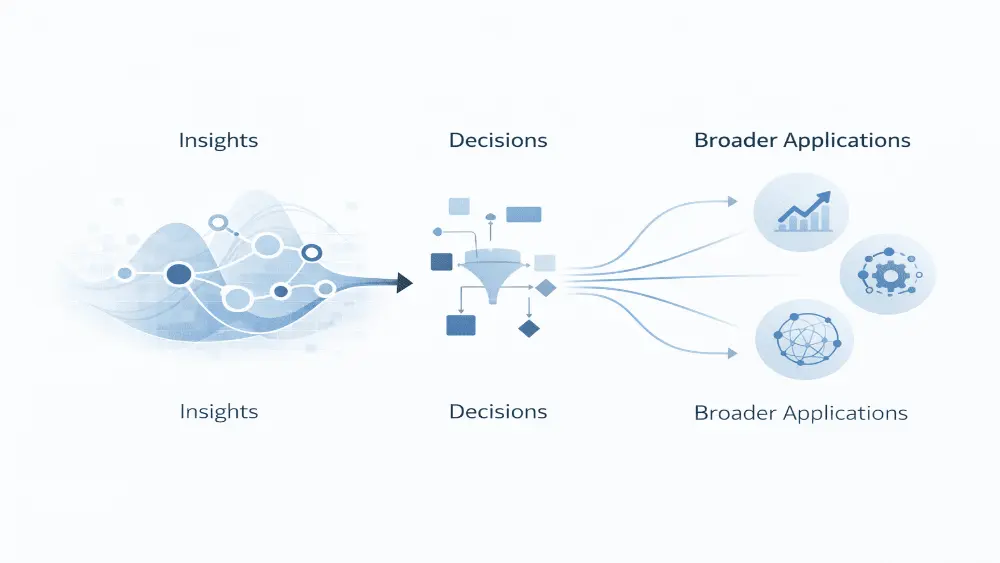
Insights and actionable intelligence are closely related, but they are not the same. An insight explains what is happening, while actionable intelligence helps determine what to do next.
In the context of DNS data, insights often take the form of observed patterns, trends, or relationships. Intelligence emerges when those observations are translated into guidance that can inform decisions.
DNS-based insights can support decision-making in several practical ways. For performance monitoring, consistent changes in DNS query timing or volume can indicate shifts in how applications are being accessed. This information helps teams understand usage patterns and anticipate capacity or reliability needs without relying on user-level data.
DNS insights also play a role in AI-driven systems. When AI agents rely on real-time signals to make decisions, DNS behavior provides a broad, low-level view of digital activity. Translating these signals into structured intelligence allows automated systems to adapt based on actual usage patterns rather than assumptions.
Actionable intelligence connects observation to outcome. It turns DNS insights into practical understanding that supports informed, timely decisions.
DNS Intelligence Beyond Cybersecurity
DNS intelligence is often associated with cybersecurity, but its value extends far beyond that single domain. While security-related applications are one use case, limiting DNS intelligence to this role overlooks its broader potential as a source of understanding about how the internet operates.
At its core, DNS sits at the beginning of nearly every digital interaction. This position makes it a powerful observability layer for the internet as a whole.
DNS data reflects how services are accessed, how platforms depend on one another, and how digital behavior changes over time. Viewed at scale, it provides a neutral, high-level perspective that is difficult to obtain from application-specific data alone.
This broader visibility is increasingly relevant for digital analytics. DNS intelligence can support performance analysis, usage trends, and ecosystem mapping without relying on detailed user data. It helps organizations understand system behavior in a way that is both scalable and adaptable.
For AI systems, DNS intelligence offers a continuous stream of real-world signals. These signals can inform learning, adaptation, and decision-making processes by reflecting actual internet activity. As digital infrastructure grows more complex, DNS intelligence becomes a foundational layer for understanding relationships, dependencies, and change across the internet—well beyond traditional security use cases.
Building a Modern DNS Intelligence Platform
A modern DNS intelligence platform is built around a series of conceptual layers that transform raw data into actionable understanding. Each layer plays a critical role in ensuring the system is scalable, reliable, and capable of supporting a wide range of applications.
The first layer is data ingestion. This involves collecting DNS data from multiple sources, ensuring that the information is comprehensive, accurate, and timely. High-quality ingestion sets the foundation for all subsequent analysis, as incomplete or inconsistent data can limit the usefulness of the platform.
Next is the processing layer. Here, raw data is cleaned, normalized, and enriched with contextual information. Processing organizes the data into a structured format, allowing patterns and relationships to be identified more effectively. This layer ensures that the platform can handle high volumes of data without sacrificing accuracy.
The intelligence generation layer focuses on analysis. Patterns, trends, and behaviors are identified to produce meaningful insights. AI and machine learning often play a role here, enabling scalable analysis of complex datasets and highlighting signals that may not be apparent through manual examination.
Finally, the output layer delivers intelligence in a usable form. Insights can be accessed through dashboards, reports, or APIs, providing a clear view of activity, trends, and dependencies.
Emphasizing modular design ensures that each layer can evolve independently, supporting scalability and future expansion while maintaining privacy and data integrity.

The Future of DNS Intelligence
The future of DNS intelligence is closely tied to how digital systems continue to evolve. As networks, applications, and services become more distributed, the need for reliable, real-time signals grows.
DNS is well-positioned to serve this role because it operates at a foundational level across the internet, providing consistent visibility into how systems connect and interact.
For AI-driven systems, DNS data offers a continuous stream of real-world activity. Rather than relying solely on static configurations or delayed reports, AI systems can use DNS-based signals to understand current conditions and adapt to change. This supports more responsive decision-making, especially in environments where behavior shifts quickly or patterns emerge gradually.
Autonomous agents also benefit from DNS intelligence. When systems are designed to act with limited human oversight, they require dependable inputs that reflect actual usage and dependencies.
DNS intelligence can help these agents understand relationships between services, detect changes in behavior, and adjust actions accordingly. This role does not require deep inspection of content, making it suitable for broad, scalable observation.
Looking ahead, DNS intelligence is likely to become a standard input layer rather than a specialized capability. As organizations seek clearer views of complex digital ecosystems, DNS data will increasingly support understanding, coordination, and adaptation—quietly enabling smarter systems without drawing attention to itself.
Conclusion: DNS Data as Strategic Intelligence
DNS data begins as a simple record of connections, generated quietly as digital systems interact. On its own, this information offers limited value.
Through careful collection, cleaning, enrichment, and analysis, however, DNS data evolves into a form of intelligence that reflects how the internet actually operates.
This transformation highlights an important shift in perspective. DNS is not merely a technical infrastructure designed to keep networks functioning. It is a strategic data layer that captures real-time signals about digital behavior, service relationships, and emerging patterns.
When treated as intelligence rather than background noise, DNS data supports a deeper understanding across complex and distributed systems.
The value of DNS intelligence lies in its breadth and neutrality. It provides visibility without relying on detailed user information and scales naturally as digital activity grows. This makes it especially relevant in an era shaped by automation, AI-driven systems, and increasing interdependence between services.
As organizations and technologies continue to evolve, the ability to interpret foundational signals will become more important than ever.
DNS data, when transformed into actionable intelligence, offers a quiet but powerful way to understand change, support informed decisions, and enable innovation across the digital landscape. To understand the broader impact and use cases of this process, revisit our guide on what DNS Intelligence is and why it matters.