
As artificial intelligence evolves from simple chatbots into autonomous systems capable of planning, coding, and solving complex problems, the demand for more capable AI models has never been greater. Among the most closely watched AI releases of 2026 is Claude Fable 5, a model that has drawn significant attention from developers, businesses, and researchers for its focus on advanced reasoning, AI agents, and enterprise-scale applications.
Developed by Anthropic, Claude Fable 5 is the company’s publicly available Mythos-class AI model, built to handle advanced reasoning, software engineering, AI agents, and enterprise knowledge work. It combines strong long-form reasoning and coding capabilities with additional safety systems that enable broader deployment across real-world applications. Rather than serving only as a conversational assistant, Claude Fable 5 is optimized to support complex workflows that require planning, analysis, and reliable decision-making.
Anthropic developed Claude Fable 5 to meet the growing need for AI systems that can process larger contexts, solve multi-step problems, and integrate seamlessly into modern software and business environments. As organizations increasingly adopt AI to improve productivity, automate workflows, and accelerate innovation, models like Claude Fable 5 are becoming an important part of the next generation of intelligent tools.
In this guide, you’ll explore Claude Fable 5’s key features, conceptual architecture, benchmarks, pricing, real-world use cases, strengths, limitations, and how it compares with other leading AI models. By the end, you’ll have a clear understanding of where Claude Fable 5 excels, where it falls short, and whether it’s the right AI model for your needs.
1. The Evolution of Claude
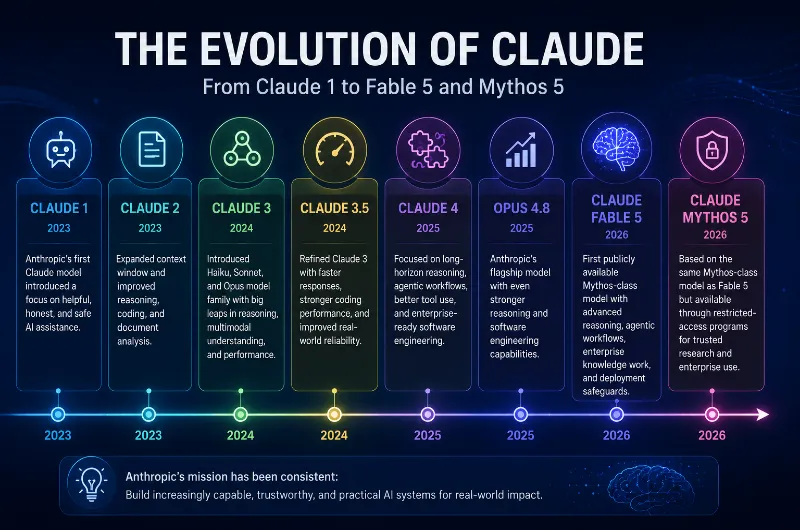
Every generation of Claude was built to solve a different challenge. Rather than simply making each model larger or faster, Anthropic focused on improving reasoning, context understanding, coding, and real-world reliability with every release. This steady evolution transformed Claude from a conversational AI assistant into a frontier AI system capable of powering software engineering, enterprise workflows, and autonomous AI agents.
| Model | Released | Why It Mattered |
| Claude 1 | 2023 | Anthropic introduced its first Claude model with a focus on building a helpful, honest, and safe AI assistant. While it offered strong conversational abilities, its reasoning, context handling, and practical capabilities were more limited than those of later generations. |
| Claude 2 | 2023 | Claude 2 addressed many early limitations by expanding the context window, improving reasoning, and strengthening coding and document analysis. These improvements made it far more useful for professional and enterprise workloads. |
| Claude 3 | 2024 | Anthropic introduced the Haiku, Sonnet, and Opus model family, giving users different options based on speed, cost, and capability. This generation also delivered major advances in reasoning, multimodal understanding, and overall performance. |
| Claude 3.5 | 2024 | Rather than waiting for a major version jump, Anthropic refined Claude 3 with faster responses, stronger coding performance, and improved real-world reliability, making it a popular choice for developers. |
| Claude 4 | 2025 | Claude 4 shifted the focus toward long-horizon reasoning, agentic workflows, improved tool use, and enterprise-ready software engineering, enabling AI to complete more complex multi-step tasks. |
| Opus 4.8 | 2025 | As Anthropic’s flagship model, Opus 4.8 further refined reasoning and software engineering capabilities while demonstrating the company’s progress toward more capable long-horizon AI systems. |
| Claude Fable 5 | 2026 | Claude Fable 5 became Anthropic’s first publicly available Mythos-class AI model, extending Claude’s capabilities into advanced reasoning, agentic workflows, software engineering, and enterprise knowledge work while incorporating additional deployment safeguards. |
| Claude Mythos 5 | 2026 | Released alongside Fable 5, Mythos 5 is based on the same underlying model but is available through restricted-access programs for trusted research and enterprise use. We’ll explore the differences between the two models later in this guide. |
Viewed together, these releases show that Anthropic’s goal has never been to build the biggest AI model—it has been to build increasingly capable, trustworthy, and practical AI systems for real-world applications. With that evolution in mind, the next section explores what Claude Fable 5 is and why it represents a major milestone in the Claude family.
2. What is Claude Fable 5?
Claude Fable 5 is Anthropic’s publicly available Mythos-class AI model, designed for advanced reasoning, software engineering, AI agents, and enterprise knowledge work. Unlike traditional chatbots that primarily respond to individual prompts, Claude Fable 5 is built to tackle complex, multi-step workflows that require planning, analysis, and reliable decision-making across real-world applications.
Anthropic positions Claude Fable 5 as a model that combines Mythos-class capabilities with additional safety systems to support broader deployment. While earlier Claude generations focused on improving conversation, coding, and context handling, Claude Fable 5 extends those capabilities to support more sophisticated reasoning, agentic workflows, and enterprise-scale tasks.
A frontier AI model refers to one of the most capable AI systems available at a given time. These models represent the state of the art in reasoning, coding, scientific research, and enterprise automation, enabling them to solve problems that were previously difficult or impossible for earlier AI systems.
Long-Horizon Reasoning
Long-horizon reasoning enables Claude Fable 5 to solve problems through multiple logical steps instead of generating a single immediate response. For example, rather than answering one coding question, it can analyze a large codebase, identify related issues, propose a solution, and explain its reasoning from start to finish.
Agentic AI
Agentic AI enables the model to assist with workflows that involve planning, decision-making, and task execution. Instead of simply answering questions, Claude Fable 5 can help coordinate multi-step processes such as software development, research projects, or business automation while working alongside users.
Adaptive Thinking
Adaptive thinking allows the model to adjust the depth of its reasoning based on the complexity of a task. Straightforward questions can be answered efficiently, while more challenging problems receive deeper analysis, helping balance speed with accuracy.
Tool Use
Modern AI systems become far more useful when they can interact with external tools. Claude Fable 5 can work with APIs, databases, search systems, development environments, and enterprise software to retrieve information, execute workflows, and support real-world decision-making beyond conversation alone.
Concept Diagram 1
User Request
│
▼
Claude Fable 5
│
▼
Reasoning
│
▼
Tool Use (if needed)
│
▼
Final Response
Concept Diagram 2
Mythos-Class Capabilities
+
Additional Safety Systems
│
▼
Claude Fable 5
Together, these capabilities make Claude Fable 5 more than a conversational AI model. It is designed to reason through complex problems, work alongside external tools, and support professional workflows across software development, research, and enterprise environments. In the next section, we’ll explore why Anthropic developed Claude Fable 5 and the challenges it was designed to solve.
3. Why Anthropic Built Claude Fable 5
Meeting the Next Generation of AI Demands
Anthropic didn’t build Claude Fable 5 simply to create a more powerful AI model—it was designed to address the growing gap between what modern users expect from AI and what earlier generations could reliably deliver. As artificial intelligence has evolved, it has moved beyond answering simple questions to assisting with software development, research, business operations, and AI agents. Today, users expect AI systems to analyze large documents, write and review code, plan complex workflows, use external tools, and solve problems that require multiple stages of reasoning.
Meeting these expectations required more than incremental improvements. It required solving several fundamental challenges that affected many frontier AI models.
The Challenges Earlier AI Models Faced
Earlier frontier AI models often performed well on individual prompts but struggled when tasks became longer, more complex, or required sustained reasoning across multiple steps. They frequently needed human guidance, found it difficult to coordinate multi-step plans, and were less consistent when working with large amounts of information. As coding assistants became more widely adopted, users also expected AI to generate, review, and debug software with greater reliability. These industry-wide challenges motivated AI developers, including Anthropic, to build more capable and dependable systems.
The table below summarizes the key challenges Claude Fable 5 is designed to address.
| Earlier Challenge | Claude Fable 5 Improvement |
| Limited autonomy | Better support for autonomous, agentic workflows |
| Short reasoning chains | More structured long-horizon reasoning |
| Weak multi-step planning | Improved planning and task coordination |
| Context limitations | Better long-context understanding |
| Less reliable coding | More dependable code generation and debugging |
| Enterprise inconsistency | Stronger performance in enterprise workflows |
Why This Matters
Anthropic’s objective with Claude Fable 5 is to move beyond traditional conversational AI and build a dependable collaborator for software engineering, research, and enterprise knowledge work. Rather than simply generating answers, the model is designed to reason through complex problems, support professional workflows, and work alongside people on demanding tasks. These improvements lay the foundation for the capabilities explored in the next section, where we’ll examine Claude Fable 5’s conceptual architecture and the technologies that enable these advancements.
4. Claude Fable 5 Architecture (Conceptual)
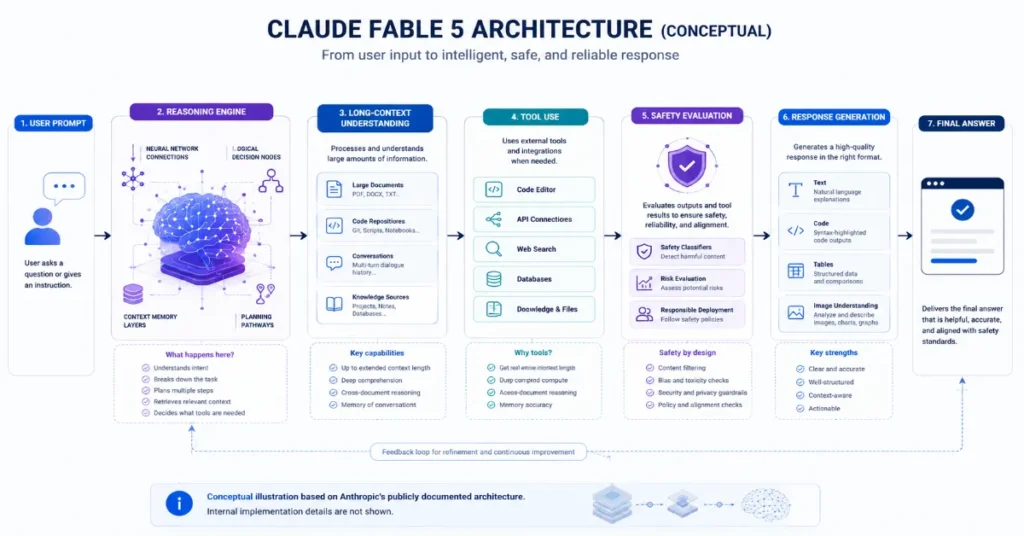
Note: Like most frontier AI developers, Anthropic has not publicly disclosed the complete internal architecture of Claude Fable 5. The explanation below describes the concepts commonly used in modern Transformer-based AI systems and serves as an educational illustration rather than a confirmed implementation.
At its core, Claude Fable 5 is conceptually built on a Transformer architecture, the foundation of most modern large language models. Unlike traditional systems that process words one at a time, Transformers analyze relationships between words and concepts simultaneously, allowing the model to better understand context, identify patterns, and generate coherent, logical responses.
Another important capability is long-context processing. A context window determines how much information an AI model can consider at once. Larger context windows enable the model to analyze lengthy research papers, review large software codebases, or maintain coherent conversations across thousands of words without losing important details.
Modern AI systems also use adaptive reasoning, conceptually allocating more reasoning effort to complex problems while responding more efficiently to straightforward requests. Combined with tool calling, the model can work alongside external resources such as APIs, databases, search systems, code execution environments, and enterprise software instead of relying solely on its internal knowledge.
It’s also important to distinguish between conversation context and persistent memory. Conversation context exists only within an active session, while persistent memory—if supported—allows certain information to be retained across sessions and depends on the product or deployment configuration rather than the underlying model itself.
Many frontier AI models are also multimodal, enabling them to understand both text and images such as screenshots, diagrams, charts, and scanned documents. In addition, agent execution allows the model to plan tasks, use tools, evaluate intermediate results, and continue workflows with limited human guidance. For example, an AI agent might analyze a bug report, search documentation, generate code, test a solution, and present the final result as part of a single workflow.
To improve reliability, modern AI systems typically incorporate multiple safety layers, including policy evaluation, safety classifiers, content filtering, and human-designed safeguards. These mechanisms help reduce unsafe or misleading outputs, although no AI system is completely error-free.
Conceptual Workflow
User Prompt
│
▼
Language Understanding
│
▼
Planning & Reasoning
│
▼
Tool Calling (Optional)
│
▼
Safety Evaluation
│
▼
Final Response
Conceptual Architecture Overview
Claude Fable 5
┌─────────────────────────┐
│ Transformer Foundation │
└─────────────────────────┘
│
┌─────────────┼─────────────┐
▼ ▼ ▼
Long-Context Adaptive Tool Calling
Processing Reasoning
│ │ │
└──────┬──────┴──────┬──────┘
▼ ▼
Memory Vision
│
▼
Agent Execution
│
▼
Safety Systems
│
▼
Final Response
Conceptual illustration: The diagrams above are simplified educational examples of how a modern frontier AI model may process requests. Anthropic has not publicly disclosed Claude Fable 5’s complete internal architecture, so the actual implementation may differ.
Rather than relying on a single capability, modern frontier AI models combine language understanding, reasoning, long-context processing, tool integration, multimodal understanding, memory, agent execution, and safety systems into a unified workflow. Together, these components enable Claude Fable 5 to support complex software engineering, research, and enterprise tasks. With this conceptual foundation in place, the next section explores the practical features that define Claude Fable 5 in everyday use.
5. Claude Fable 5 Features
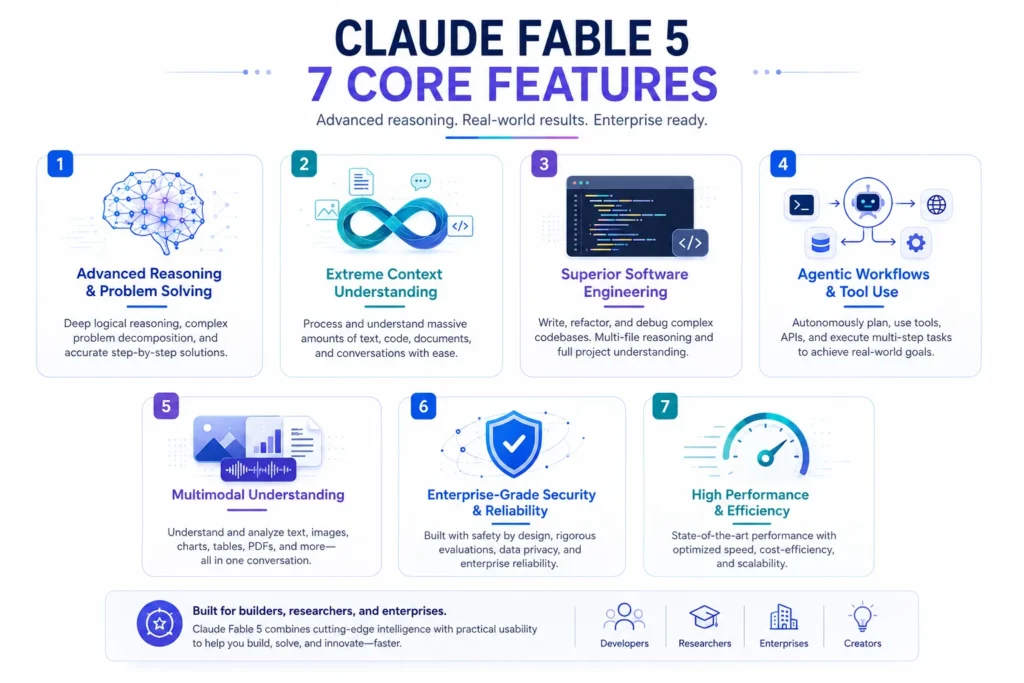
Claude Fable 5 combines several capabilities that enable it to support complex reasoning, software development, enterprise knowledge work, and AI-powered automation. Rather than functioning as a traditional chatbot, it is designed to assist with multi-step workflows across a wide range of professional tasks. The following features highlight how modern frontier AI models can improve productivity across different industries.
Advanced Reasoning
Advanced reasoning allows Claude Fable 5 to tackle problems that require multiple logical steps instead of generating an immediate response from a single prompt. Rather than treating each question independently, the model can break a complex task into smaller parts, evaluate different approaches, and work toward a well-reasoned solution. This makes it particularly valuable for analytical and decision-making tasks.
For example, a startup founder could ask Claude Fable 5 to evaluate three business expansion strategies. Instead of simply listing advantages and disadvantages, the model can compare costs, risks, market opportunities, and long-term trade-offs before presenting a structured recommendation.
Who benefits?
- Developers solving technical problems
- Researchers analyzing complex topics
- Business leaders making strategic decisions
Software Engineering & Coding
Claude Fable 5 is designed to assist with many stages of the software development lifecycle. Developers can use it to write code, explain unfamiliar functions, refactor existing projects, review pull requests, identify bugs, generate unit tests, and create technical documentation.
It supports widely used programming languages such as Python, JavaScript, Rust, and Go, making it suitable for a broad range of development projects.
Example Coding Workflow
Project Idea
↓
Generate Code
↓
Debug Errors
↓
Refactor
↓
Generate Tests
↓
Document Code
By assisting throughout the development process, Claude Fable 5 can help developers spend less time on repetitive tasks and more time solving complex engineering challenges.
Who benefits?
- Software engineers
- DevOps teams
- Startup developers
- Computer science students
Long-Context Processing
One of the defining capabilities of modern frontier AI models is long-context processing.
A token is the basic unit of text that an AI model processes. A context window refers to the amount of information the model can consider during a single interaction. Larger context windows allow the model to retain more information without losing important details.
Context Illustration
Small Context
██████
Large Context
██████████████████████████████
Long-context processing enables Claude Fable 5 to work with lengthy research papers, legal contracts, technical documentation, financial reports, and large software codebases within a single conversation. This reduces the need to split large documents into smaller sections and helps maintain continuity throughout the task.
For example, a legal team could upload a lengthy contract and ask the model to identify potential risks, summarize key clauses, and compare revisions without repeatedly re-uploading different sections.
Who benefits?
- Lawyers
- Researchers
- Enterprise teams
- Software developers
AI Agents
Traditional chatbots respond to one prompt at a time. AI agents go a step further by working through a sequence of related actions to achieve a broader objective.
To better understand how autonomous AI workflows differ from traditional automation, read Automation vs Agentic AI: Key Differences, Use Cases and the Future of Work in 2026.
Claude Fable 5 can conceptually assist with workflows involving planning, using external tools, verifying intermediate results, and continuing until the requested task is complete.
Agent Workflow
Goal
↓
Plan
↓
Use Tools
↓
Verify
↓
Complete Task
For example, a developer investigating a software bug could ask the model to analyze error logs, review project documentation, inspect relevant code, suggest a fix, and verify whether the solution resolves the issue.
Who benefits?
- Developers
- Operations teams
- Businesses building AI automation
- Enterprise users
Vision
As a multimodal AI model, Claude Fable 5 can work with both text and visual content. Depending on the application, it can conceptually analyze screenshots, charts, diagrams, scanned documents, and PDFs alongside written instructions.
For example, an engineer could upload a network architecture diagram and ask the model to explain how different systems communicate. Likewise, a business analyst could share a dashboard screenshot and request insights into performance trends.
Who benefits?
- Engineers
- Analysts
- Designers
- Researchers
Enterprise Knowledge
Organizations store valuable information across contracts, spreadsheets, internal documentation, knowledge bases, and reports. Claude Fable 5 can help users extract key insights, summarize documents, compare information, and answer questions based on large collections of business content.
In many enterprise deployments, AI systems work alongside document repositories or knowledge bases to retrieve relevant information before generating responses, making them useful for organization-wide knowledge management.
For example, an HR team could compare multiple company policy documents and quickly identify important differences before updating employee guidelines.
Who benefits?
- Enterprise organizations
- Legal teams
- HR departments
- Financial analysts
Tool Calling
Modern AI becomes significantly more useful when it can interact with external systems instead of relying only on its built-in knowledge.
Depending on the application and deployment, Claude Fable 5 can conceptually work alongside APIs, web search, databases, browsers, code execution environments, and enterprise software. The availability of these tools depends on the application integrating the model rather than the model itself.
Conceptual Workflow
User Request
↓
Reasoning
↓
Call Tool or API
↓
Analyze Result
↓
Final Response
For example, instead of estimating current inventory levels, the model could retrieve live data from a company’s database, analyze the results, and generate a report using the latest available information.
Who benefits?
- Developers
- Enterprise teams
- IT administrators
- Businesses building AI-powered applications
Feature Summary
| Feature | Primary Benefit | Typical Users |
| Advanced Reasoning | Solves complex multi-step problems with structured analysis | Researchers, business leaders |
| Software Engineering | Assists with coding, debugging, testing, and documentation | Developers |
| Long-Context Processing | Understands large documents and lengthy conversations | Enterprises, legal teams |
| AI Agents | Supports multi-step planning and workflow automation | Operations teams |
| Vision | Analyzes images, charts, diagrams, and documents | Engineers, analysts |
| Enterprise Knowledge | Extracts insights from business information | Organizations |
| Tool Calling | Connects AI with external systems | Developers, enterprise users |
Together, these capabilities illustrate how Claude Fable 5 extends beyond traditional conversational AI into a platform for reasoning, software engineering, and enterprise workflows. In the next section, we’ll explore what’s new in Claude Fable 5 and how these capabilities build upon earlier Claude generations.
6. Claude Fable 5 Benchmarks Explained
When a new AI model is released, benchmark scores often receive significant attention. However, the numbers alone don’t tell the whole story. An AI benchmark is a standardized test designed to evaluate a specific capability of an AI model under consistent conditions. Rather than measuring overall intelligence, each benchmark focuses on a particular skill—such as reasoning, coding, document understanding, or image analysis—making it easier to compare models objectively.
Anthropic evaluates its AI models using a combination of internal testing and widely recognized public benchmarks. These evaluations help measure capabilities such as software engineering, reasoning, vision, long-context understanding, and scientific problem-solving. Understanding what each benchmark measures makes it easier to interpret Anthropic’s published results and understand how those capabilities translate into real-world applications.
Software Engineering
Software engineering benchmarks evaluate how effectively an AI model can write, understand, debug, refactor, and improve code. Some evaluations also assess whether the model can solve real software engineering problems using existing codebases.
Why it matters: Strong coding performance can help developers automate repetitive programming tasks, identify bugs more quickly, and improve overall productivity.
Example: A developer asks Claude Fable 5 to investigate a failing test, identify the root cause, suggest a code fix, and explain why the issue occurred.
Knowledge Work
Knowledge work benchmarks assess how well a model understands, summarizes, compares, and analyzes large volumes of information, including reports, contracts, research papers, and business documents.
Why it matters: Professionals spend a significant amount of time reviewing information. AI models that perform well in this area can accelerate research, reporting, and decision-making.
Example: A financial analyst summarizes several quarterly reports, compares performance trends, and prepares key insights for an executive meeting.
Reasoning
Reasoning benchmarks measure a model’s ability to solve problems that require multiple logical steps instead of generating an immediate answer.
Why it matters: Strategic planning, technical troubleshooting, and research often require structured thinking rather than simple question answering.
Example: A startup founder compares multiple expansion strategies by evaluating market demand, costs, competition, risks, and long-term growth opportunities.
Vision
Vision benchmarks evaluate how well a multimodal AI model understands visual information, including images, charts, diagrams, screenshots, scanned documents, and PDFs.
Why it matters: Many real-world workflows combine text with visual information, requiring AI to interpret both accurately.
Example: An engineer uploads a network architecture diagram and asks Claude Fable 5 to explain how different components communicate, identify potential bottlenecks, and summarize the overall system design.
Long-Context Understanding
Long-context benchmarks evaluate how well an AI model maintains understanding across very large inputs, such as lengthy documents, long conversations, or extensive software repositories.
Why it matters: Businesses often work with hundreds of pages of documentation, making long-context understanding essential for accurate analysis.
Example: A legal team reviews a lengthy contract and asks the model to identify important clauses, summarize obligations, and highlight potential risks without splitting the document into smaller sections.
Enterprise Tasks
Enterprise task evaluations measure how effectively an AI model performs practical business workflows, such as document analysis, extracting structured information, workflow automation, integrating with business tools, and supporting organizational decision-making.
Why it matters: Organizations need AI systems that can reliably assist employees across departments while improving efficiency and reducing repetitive work.
Example: An HR department compares multiple versions of company policies and generates a summary of the latest changes before distributing updated guidelines.
Scientific Reasoning
Scientific reasoning benchmarks evaluate how well a model interprets technical information, analyzes data, solves mathematical problems, and supports evidence-based research.
Why it matters: Researchers and technical professionals rely on AI to assist with complex analytical tasks while maintaining logical consistency.
Example: A researcher asks Claude Fable 5 to summarize recent scientific literature, compare competing hypotheses, and identify areas where further research may be needed.
Note: The explanations in this section are intended to help readers understand common AI benchmark categories. Published benchmark results should always be interpreted alongside real-world testing and the official documentation released by the model developer.
Benchmark Summary
| Benchmark Area | What It Measures | Why It Matters |
| Software Engineering | Code generation, debugging, and code understanding | Improves developer productivity |
| Knowledge Work | Document analysis and summarization | Accelerates business workflows |
| Reasoning | Multi-step problem solving and planning | Supports better decision-making |
| Vision | Understanding images and visual documents | Enables multimodal workflows |
| Long-Context | Processing lengthy inputs | Helps analyze large documents and codebases |
| Enterprise Tasks | Business workflows and productivity | Improves organizational efficiency |
| Scientific Reasoning | Research, mathematics, and data analysis | Assists technical and scientific work |
Key Insight
- Benchmarks evaluate specific capabilities rather than overall intelligence.
- Strong performance in one benchmark does not guarantee the best performance for every real-world task.
- Official benchmark results provide a standardized way to compare AI models, but practical testing remains equally important.
- Different benchmark categories matter to different users. Developers may prioritize software engineering evaluations, while researchers may focus more on reasoning, scientific analysis, and long-context understanding.
While benchmarks provide a useful snapshot of an AI model’s capabilities, they cannot fully capture how it performs in everyday work. The next section moves beyond standardized evaluations to explore how Claude Fable 5 can be applied across real-world software development, business operations, research, and enterprise workflows.
8. Real-World Use Cases
While benchmarks demonstrate how an AI model performs under standardized tests, real-world use cases show how those capabilities translate into everyday work. Claude Fable 5 is designed to support a wide range of professional workflows—from software development and business operations to research and content creation. Rather than replacing human expertise, it serves as an intelligent assistant that helps users analyze information, automate repetitive tasks, and make more informed decisions.
Developers
Claude Fable 5 can assist developers throughout the software development lifecycle. It helps with building web and mobile applications, generating APIs, writing and explaining code, debugging errors, refactoring existing projects, creating unit tests, and producing technical documentation.
Example: A developer building a REST API can ask the model to generate endpoint templates, explain implementation choices, identify bugs during testing, and produce developer documentation. By assisting throughout the development process, Claude Fable 5 can reduce repetitive work, speed up debugging, improve code quality, and allow developers to focus on solving higher-level engineering challenges.
Businesses
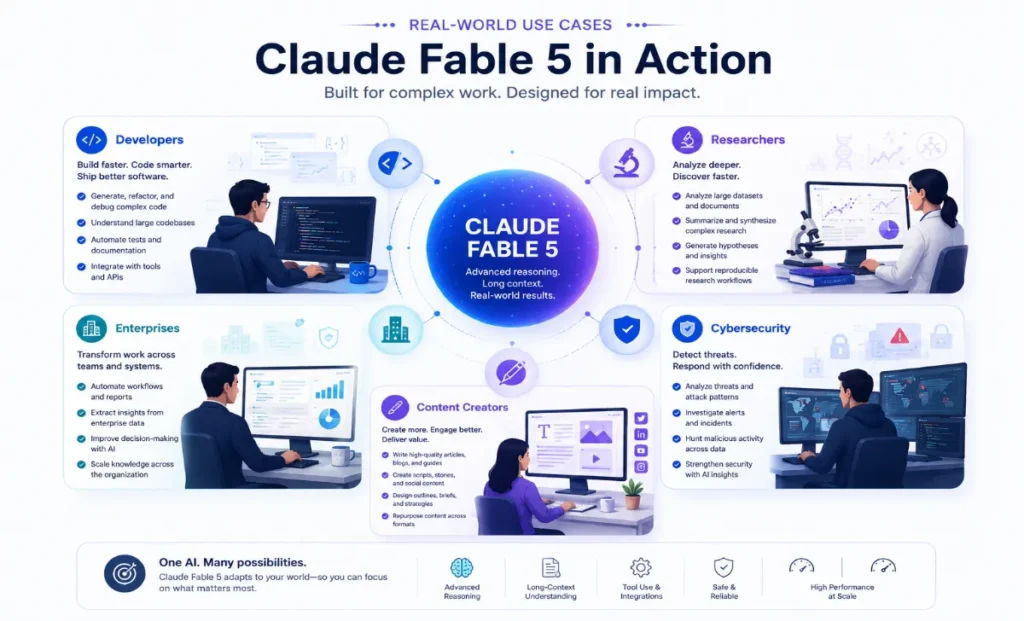
Organizations can use Claude Fable 5 to streamline knowledge-intensive workflows, improve collaboration, and support faster decision-making. Common applications include customer support assistance, internal knowledge search, report generation, meeting summaries, workflow automation, and document analysis.
Example: A customer support team can quickly search internal documentation to answer customer questions, while managers can generate concise summaries from lengthy meeting transcripts or business reports, enabling teams to make informed decisions more efficiently.
Researchers
Researchers and students can use Claude Fable 5 to accelerate knowledge-intensive work. It can summarize research papers, compare findings from multiple studies, organize references, explain complex concepts, and help brainstorm research ideas.
Example: A graduate student reviewing dozens of academic papers can use the model to summarize each study, identify recurring themes, and compare differing conclusions before conducting a detailed literature review. Although AI can significantly reduce research time, important findings should always be verified against the original sources.
Cybersecurity Professionals
Cybersecurity teams can use Claude Fable 5 to assist with threat analysis, malware explanations, security documentation, log analysis, incident report summarization, and vulnerability explanations.
Example: A security analyst investigating suspicious DNS activity can use the model to summarize DNS logs, explain indicators of compromise, draft an incident report, and identify areas that require further investigation. While AI can accelerate analysis and documentation, security decisions should always be reviewed and validated by experienced professionals.
Content Creators
Content creators can use Claude Fable 5 to streamline writing and research workflows. It can assist with blog writing, SEO research, content outlining, editing, email drafting, social media content, and repurposing long-form articles into multiple formats.
Example: A marketing team can transform a detailed research report into a blog post, newsletter, LinkedIn article, and email campaign while maintaining a consistent message. It can also help identify search intent, improve readability, and optimize content for SEO before publication. Human review remains essential to ensure factual accuracy, originality, and alignment with the intended audience.
Use Case Summary
| Audience | Common Tasks | Primary Benefit |
| Developers | Coding, debugging, APIs, documentation | Faster software development |
| Businesses | Reports, knowledge search, customer support | Improved productivity and decision-making |
| Researchers | Literature reviews, summarization, research analysis | Faster research workflows |
| Cybersecurity Professionals | Threat analysis, DNS log analysis, incident reports | More efficient security investigations |
| Content Creators | Writing, SEO, editing, content repurposing | More efficient content creation |
Key Takeaways
- Claude Fable 5 supports a wide range of professional workflows across technical and non-technical fields.
- Different industries benefit from different capabilities, from coding assistance to enterprise knowledge analysis.
- Advanced reasoning, long-context understanding, and tool integration enable more complex and productive workflows.
- Human expertise remains essential for validating important decisions and reviewing AI-generated outputs.
- AI is most effective as a collaborative assistant that enhances productivity rather than replacing professional judgment.
These examples demonstrate that Claude Fable 5 is more than a conversational AI model. Its combination of advanced reasoning, coding assistance, long-context understanding, and enterprise-focused capabilities makes it a versatile tool for developers, businesses, researchers, cybersecurity professionals, and content creators. In the next section, we’ll examine Claude Fable 5 Pricing, including available plans, access options, and what different users can expect.
9. Claude Fable 5 Pricing
Claude Fable 5 is available through the Anthropic API, where usage is billed based on the number of tokens processed rather than the number of requests. According to Anthropic’s published pricing at the time of writing, Claude Fable 5 costs $10 per million input tokens and $50 per million output tokens. Because AI pricing can change over time, it’s a good idea to check Anthropic’s official pricing page for the latest rates before building a production application.
Understanding Tokens
A token is a small unit of text processed by an AI model. Your prompt consumes input tokens, while the model’s generated response consumes output tokens. Billing is based on the total number of tokens processed, making pricing proportional to the amount of work performed.
Your Prompt
↓
Input Tokens
↓
Claude Fable 5
↓
Generated Response
↓
Output Tokens
Prompt Caching
Anthropic also offers prompt caching, which can reduce costs for applications that repeatedly send the same instructions or reference material. Instead of reprocessing identical prompts each time, cached content can be reused, lowering both latency and token costs. This is particularly useful for AI assistants, customer support systems, and enterprise applications with consistent workflows.
Enterprise & Cloud Access
For organizations with larger deployments, Anthropic provides enterprise offerings that may include higher usage limits, administrative controls, security and compliance features, team management, and dedicated support. Claude models are also available through supported cloud platforms and managed AI services, although availability, pricing, and features may vary by provider.
Who Should Pay for Claude Fable 5?
- Individual developers: Ideal for building and testing AI-powered applications through the API.
- Startups: Suitable for integrating AI into customer-facing products and internal tools.
- Businesses: Useful for automating workflows, knowledge management, and productivity applications.
- Enterprises: Best for organizations requiring governance, security, and scalable AI deployments.
- Researchers: Appropriate for large-scale experiments and advanced AI-assisted analysis.
- Casual users: A subscription-based Claude plan may be more cost-effective than API pricing if you primarily interact through a chat interface.
Pricing Summary
| Item | Details |
| API Pricing | $10 per million input tokens |
| Output Pricing | $50 per million output tokens |
| Billing Model | Pay per token processed |
| Prompt Caching | Available with discounted cached tokens |
| Enterprise | Custom plans with additional enterprise features |
| Cloud Providers | Available through supported cloud platforms and managed AI services |
Key Takeaway
- Claude Fable 5 uses a token-based pricing model through the Anthropic API.
- Input and output tokens are billed separately.
- Prompt caching can reduce costs for applications that reuse prompts or context.
- Enterprise deployments provide additional management, security, and governance capabilities.
- The most suitable access option depends on your workload, deployment requirements, and budget.
With pricing and access options covered, the next section compares Claude Fable 5 with other leading AI models to see how it differs in capabilities, performance, and intended use cases.
10. Claude Fable 5 vs Competitors
Choosing a frontier AI model involves more than comparing benchmark scores. While benchmarks provide useful insights into specific capabilities, they do not fully reflect how a model performs in real-world workflows. Factors such as coding ability, reasoning, multimodal support, safety, ecosystem integration, pricing, and enterprise readiness all influence which model is the best fit for a particular use case.
Note: The comparison below is based on publicly available information from official documentation and widely recognized capabilities. Features, pricing, and availability may change over time, and some information about Claude Fable 5 has not been publicly documented.
Comparison Table
| Capability | GPT-5.5 | Gemini | DeepSeek | Claude Sonnet 5 | Claude Fable 5 |
|---|---|---|---|---|---|
| Coding | Strong software engineering, debugging, and code generation | Strong coding with Google ecosystem integration | Cost-effective coding and code generation | Optimized for fast coding and developer productivity | Publicly positioned for advanced software engineering |
| Reasoning | Strong multi-step reasoning and problem solving | Strong reasoning across text and multimodal tasks | Competitive reasoning for technical tasks | Strong reasoning for everyday professional work | Publicly positioned for advanced reasoning capabilities |
| AI Agents | Supports tool use and agentic workflows | Supports agentic workflows and tool integration | Varies by deployment | Supports tool use and multi-step workflows | Publicly positioned for AI agents and enterprise workflows |
| Context | Supports large-context processing (limits vary by deployment) | Supports large-context processing | Context limits vary by deployment | Supports large-context workflows | Publicly positioned for long-context reasoning |
| Vision | Strong multimodal understanding of images and documents | Strong multimodal capabilities with Google services | Supports vision in supported deployments | Strong image and document understanding | Publicly positioned for multimodal enterprise workflows |
| Speed | Balanced for interactive and complex tasks | Balanced across productivity and reasoning | Often optimized for fast responses | Optimized for responsive everyday use | Not publicly documented |
| Cost | Premium | Premium | Generally budget-friendly | Mid-range | Premium API pricing publicly announced |
| Safety | Enterprise safety features and responsible AI practices | Enterprise safeguards and Google AI policies | Varies by deployment and provider | Built with Anthropic’s Constitutional AI approach | Publicly positioned with additional deployment safety systems |
| Best For | Developers, researchers, enterprise teams | Google Workspace users and multimodal workflows | Cost-conscious developers and startups | Everyday coding, writing, and business productivity | Advanced reasoning, software engineering, AI agents, and enterprise knowledge work (based on Anthropic’s public positioning) |
What This Comparison Suggests
Each model serves a different audience and set of priorities. GPT-5.5 is well-suited for users seeking a versatile AI assistant with strong reasoning, coding, and a broad ecosystem. Gemini is particularly attractive for organizations already using Google’s cloud and productivity tools, while DeepSeek has gained attention for delivering capable coding and reasoning at a lower cost.
Within Anthropic’s lineup, Claude Sonnet 5 is designed as a fast, general-purpose model for everyday professional work. By contrast, Claude Fable 5 is publicly positioned as a Mythos-class model focused on advanced reasoning, software engineering, AI agents, and enterprise knowledge work. However, Anthropic has not publicly disclosed every technical detail of Fable 5, so some implementation specifics remain unavailable.
It’s also important to remember that context limits, tool availability, multimodal features, and pricing can vary depending on whether a model is accessed directly from the provider or through a cloud platform.
Key Insights
AI models evolve rapidly, so consult the latest official documentation before making long-term technical or business decisions.
No single AI model is the best choice for every workload.
Select a model based on your specific tasks, workflow, ecosystem, and budget—not benchmark rankings alone.
Public benchmarks provide valuable comparisons, but real-world testing is equally important.
Enterprise users often prioritize governance, reliability, security, and safety alongside raw performance.
This comparison provides a high-level view of where Claude Fable 5 fits within today’s frontier AI landscape. In the next section, we’ll explore Claude Fable 5 vs Mythos 5, explaining their relationship, intended use cases, and key differences based on publicly available information.
12. Claude Fable 5 vs Mythos 5
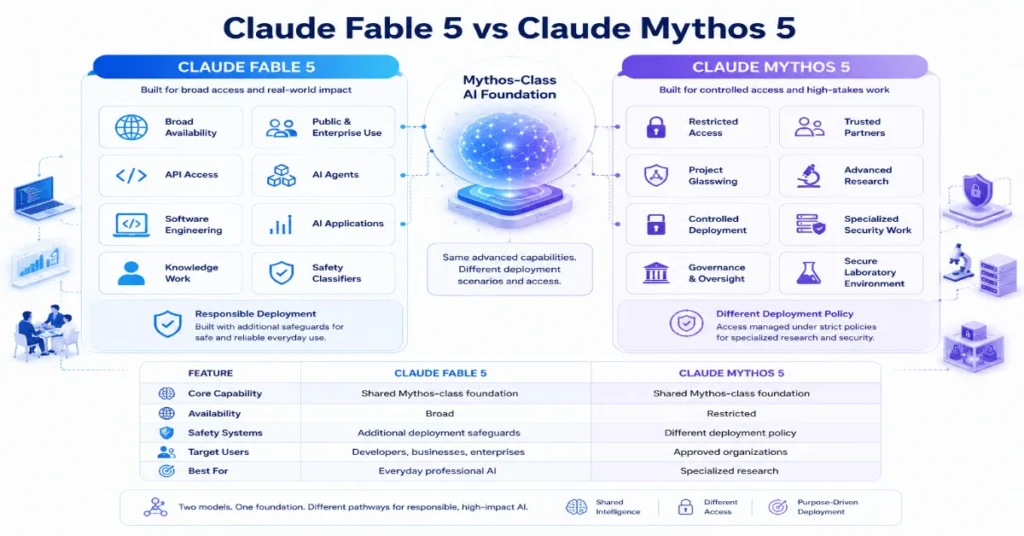
When comparing Claude Fable 5 vs Mythos 5, it’s important to understand that they are not two completely different AI systems. According to Anthropic, both are built on the company’s Mythos-class AI foundation, but they are designed for different deployment scenarios. The primary differences involve access, safety systems, and governance, rather than fundamentally different intelligence or capabilities.
Why Two Models?
Anthropic introduced both Claude Fable 5 and Claude Mythos 5 to balance powerful AI capabilities with responsible deployment. Claude Fable 5 is intended for broad public and enterprise use, while Claude Mythos 5 is designed for carefully controlled environments where approved organizations require fewer restrictions for specialized, high-impact work, such as advanced cybersecurity research. This approach allows Anthropic to make Mythos-class AI broadly accessible while applying stricter access controls to higher-risk use cases.
Same Mythos-Class Foundation
Anthropic states that Claude Fable 5 and Claude Mythos 5 share the same Mythos-class foundation. Rather than representing separate generations of AI, they are different deployment variants built on the same underlying technology. The key distinction lies in how they are governed. Claude Fable 5 incorporates additional safety systems for public deployment, while Claude Mythos 5 is made available under different safety policies through Anthropic’s trusted access program.
Safety Systems
Claude Fable 5 is designed for responsible public deployment. It includes safety classifiers that may decline, redirect, or apply additional safeguards to certain high-risk requests. Anthropic also documents that, in some restricted domains, requests may be handled by Claude Opus 4.8 instead of Claude Fable 5. These safeguards are intended to reduce the risk of misuse while allowing the model to remain useful for legitimate professional and enterprise applications.
Why Claude Mythos 5 Exists
Anthropic created Claude Mythos 5 because some trusted organizations require access to advanced AI capabilities under specialized research or operational conditions. Instead of making this level of access publicly available, Anthropic limits it to approved partners working on eligible high-impact projects. This approach supports advanced research while maintaining tighter oversight of potentially sensitive applications.
Who Can Access Mythos 5?
Claude Mythos 5 is not generally available. According to Anthropic, access is currently limited to approved organizations through Project Glasswing, with a broader trusted access program planned over time. Access is granted only to organizations that meet Anthropic’s eligibility requirements, and availability may also depend on participating cloud providers and regional support.
Who Should Use Claude Fable 5?
For most users—including individual developers, startups, businesses, researchers, and enterprise teams—Claude Fable 5 is the recommended choice. It provides Mythos-class capabilities while remaining generally available through Anthropic’s API, Claude applications, and supported cloud platforms. For the vast majority of software development, business, research, and enterprise workflows, Claude Fable 5 offers the capabilities users need without requiring participation in a restricted access program.
Comparison Summary
The table below summarizes the key differences between Claude Fable 5 and Claude Mythos 5 based on Anthropic’s published documentation.
| Feature | Claude Fable 5 | Claude Mythos 5 |
|---|---|---|
| Core Capability | Mythos-class model | Mythos-class model |
| Underlying Model | Same underlying model | Same underlying model |
| Safety Systems | Additional safety classifiers | Safety classifiers removed in certain approved scenarios |
| Availability | Generally available | Limited availability |
| Target Users | Developers, businesses, enterprises, researchers | Approved organizations and trusted partners |
| Access | Claude apps, API, and supported cloud platforms | Project Glasswing and approved access programs |
| Deployment | Broad public and enterprise deployment | Controlled, high-trust deployments |
| Best For | Everyday professional and enterprise AI use | Specialized cybersecurity and approved research projects |
Key Takeaways
Key Takeaways
-For almost all developers, businesses, and researchers, Claude Fable 5 is the appropriate and recommended choice.
-Both Claude Fable 5 and Claude Mythos 5 are built on Anthropic’s Mythos-class technology.
-Anthropic states they share the same underlying model and capabilities.
-Claude Fable 5 adds safety classifiers for broad public and enterprise deployment.
-Claude Mythos 5 is restricted to approved organizations through Project Glasswing and related trusted access programs.
13. Claude Fable 5 Safety
As frontier AI models become more capable, they can assist with increasingly sensitive and high-impact tasks, from writing software and analyzing complex documents to supporting scientific research and enterprise workflows. These capabilities create significant opportunities for productivity, but they also increase the potential for misuse. According to Anthropic, its safety approach is designed to balance powerful AI capabilities with responsible deployment, making Claude Fable 5 suitable for developers, businesses, researchers, and enterprise users.
Safety Classifiers
A safety classifier is an additional evaluation layer that helps assess whether a request falls within the model’s safety policies. Rather than simply allowing or blocking requests, it evaluates the context and may allow the request, provide a safer alternative, request clarification, or decline to respond when appropriate. Anthropic has not publicly disclosed the technical implementation of these classifiers, but describes them as an important part of its broader responsible AI strategy.
Jailbreak Prevention
Some users attempt to bypass an AI model’s safeguards through techniques commonly known as jailbreaks. Anthropic continually researches methods to improve jailbreak resistance, helping the model remain aligned with its safety policies even when users attempt to circumvent them. Like all AI safety systems, these protections continue to evolve as new attack techniques and defense strategies emerge.
Cybersecurity Safeguards
Anthropic documents additional protections for certain high-risk cybersecurity requests. The objective is to reduce assistance that could facilitate harmful cyber activity while continuing to support legitimate defensive security work, education, and research where appropriate. Not every cybersecurity question is restricted; requests are evaluated according to Anthropic’s published safety policies.
Biology and Chemical Safeguards
Anthropic also applies additional safeguards to some biology and chemistry-related requests because these fields may involve elevated misuse risks. Educational discussions, scientific explanations, and legitimate research remain supported within the model’s safety policies, while requests that could meaningfully enable harmful activities may receive additional review or alternative handling.
Distillation Protections
Anthropic has discussed protections against unauthorized model distillation. Distillation is a technique that can be used to create a smaller model by learning from a more capable one. Anthropic’s protections are intended to reduce unauthorized extraction or replication of frontier model capabilities, helping preserve model integrity and intellectual property while supporting responsible AI deployment.
Fallback Behavior
For certain high-risk categories documented by Anthropic, requests may receive additional safety review. Depending on the situation, the system may refuse the request, provide a safer response, or—in specific documented cases—route the request to Claude Opus 4.8 instead of Claude Fable 5. This behavior applies only to particular scenarios described in Anthropic’s public documentation.
Conceptual illustration (simplified):
User Request
│
▼
Safety Evaluation
│
┌────┴────┐
│ │
Safe Higher Risk
│ │
▼ ▼
Claude Additional Safeguards
Fable 5 │
▼
Alternative Handling
Why Safety Matters
AI safety is ultimately a deployment trade-off. Rather than viewing safeguards simply as restrictions, they can also be understood as deployment decisions that help make advanced AI systems suitable for enterprise software, education, healthcare, scientific research, government, and other environments where reliability, governance, and risk management are essential. Different AI providers make different design choices, and Anthropic’s approach emphasizes balancing powerful capabilities with responsible public deployment.
Safety Summary
| Safety Area | Purpose |
| Safety Classifiers | Evaluate potentially risky requests and determine appropriate handling |
| Jailbreak Prevention | Reduce attempts to bypass model safeguards |
| Cybersecurity Safeguards | Limit harmful cyber assistance while supporting legitimate defensive use |
| Biology Safeguards | Reduce biological misuse risks |
| Chemical Safeguards | Reduce hazardous chemistry misuse |
| Distillation Protections | Help protect model integrity and intellectual property |
| Fallback Behavior | Apply alternative handling for certain documented high-risk requests |
Key Takeaways
- Claude Fable 5 combines advanced AI capabilities with multiple layers of safety.
- Anthropic’s safeguards are designed to support responsible public and enterprise deployment.
- Additional protections apply to specific high-risk domains such as cybersecurity, biology, and chemistry.
- Safety systems balance usefulness with risk management rather than simply restricting model behavior.
- Understanding these safeguards helps explain why Claude Fable 5 may respond differently depending on the context of a request.
While these safety systems support responsible deployment, no AI model is without limitations. In the next section, we’ll examine Claude Fable 5 Limitations, including practical constraints and scenarios where human expertise remains essential.
13. Who Should Use Claude Fable 5?
After exploring Claude Fable 5’s capabilities, a common question remains: Who is it actually designed for? The answer depends on your goals and workflow. Claude Fable 5 is intended for users whose work involves complex reasoning, software development, document analysis, or knowledge-intensive tasks. The following guidance can help you decide whether it fits your needs.
Students
Students can use Claude Fable 5 to explain difficult concepts, summarize textbooks, organize study notes, create revision plans, and improve the clarity and structure of their writing while maintaining original work. It works best as a learning companion that supports understanding rather than replacing independent study or academic integrity.
Researchers
Researchers and academics can use Claude Fable 5 to streamline literature reviews, summarize research papers, compare findings across multiple sources, organize information, and brainstorm research questions. While these capabilities can save time, important conclusions should always be verified using the original publications and supporting evidence.
Software Engineers
Software engineers are among the users who can benefit most from Claude Fable 5. It can assist with writing code, debugging, refactoring, generating unit tests, explaining unfamiliar or legacy code, creating technical documentation, and working with large codebases. Its long-context capabilities are particularly valuable when analyzing complex software projects spanning multiple files or helping developers become familiar with existing codebases.
AI Startups
AI startups can integrate Claude Fable 5 through Anthropic’s API to build intelligent assistants, customer support systems, workflow automation tools, internal knowledge platforms, and other AI-powered applications. Features such as prompt caching can also help reduce API costs for repeated workflows, depending on the application’s architecture.
Enterprise Organizations
Enterprise teams can use Claude Fable 5 for document analysis, knowledge management, report generation, workflow automation, and internal collaboration. Its ability to process large amounts of information makes it well suited for organizations working with contracts, policies, technical documentation, and other business records. Enterprise deployment features, administrative controls, and availability may vary depending on the platform and service provider.
Security Analysts
Security professionals can use Claude Fable 5 to assist with log analysis, incident report drafting, vulnerability explanations, security documentation, and threat intelligence summaries. As with any AI system, it is intended to support—not replace—professional judgment, and high-risk cybersecurity requests are handled in accordance with Anthropic’s published safety policies.
Content Marketers
Content marketers can use Claude Fable 5 to streamline blog writing, SEO research, content planning, editing, email campaigns, social media drafts, and content repurposing. It can also help maintain a consistent tone and messaging across multiple content formats. Human review remains essential to ensure factual accuracy, originality, and alignment with a brand’s voice and editorial standards.
Decision Matrix
| User Type | Recommendation | Why Claude Fable 5 Fits |
|---|---|---|
| Students | ✅ Good Fit | Explains concepts, summarizes learning materials, and helps organize study plans. |
| Researchers | ✅ Strong Fit | Streamlines literature reviews, document analysis, and research organization. |
| Software Engineers | ⭐ Excellent Fit | Assists with coding, debugging, refactoring, testing, and large codebases. |
| AI Startups | ⭐ Excellent Fit | Enables AI-powered products, automation, and API-based integrations. |
| Enterprise Teams | ⭐ Excellent Fit | Improves knowledge management, document analysis, and business workflows. |
| Security Analysts | ✅ Strong Fit | Supports defensive security analysis and technical documentation within published safety policies. |
| Content Marketers | ✅ Strong Fit | Speeds up research, writing, editing, SEO, and content repurposing. |
Who Might Need a Different Option?
Claude Fable 5 may not be the ideal choice for every situation. Casual users with occasional AI needs may find a subscription-based chatbot sufficient without using the API. Budget-conscious projects with relatively simple requirements may prefer a lower-cost model, while organizations that require capabilities, integrations, or deployment options not currently supported by their preferred platform should carefully evaluate available alternatives before making a decision.
Key Takeaways
The best AI model depends on your workload, budget, deployment requirements, and preferred ecosystem.
Claude Fable 5 is designed for professional, technical, and enterprise-oriented workflows.
Software engineers and AI startups benefit from its coding, reasoning, and automation capabilities.
Researchers and students can use it to streamline knowledge-intensive tasks while continuing to verify important information.
Enterprise organizations gain value from document analysis, knowledge management, and workflow automation.
Understanding who benefits most from Claude Fable 5 makes it easier to decide whether it aligns with your goals and workflows. In the next section, we’ll bring everything together with a Final Verdict, summarizing the model’s strengths, limitations, and the types of users who are most likely to benefit from adopting it.
18. Frequently Asked Questions (FAQ)
Is Claude Fable 5 free?
Claude Fable 5 may be available through supported Claude subscription plans for interactive use, while developers can access it through the Anthropic API using token-based pricing. API usage is billed based on input and output tokens, so costs depend on how much the model is used.
What makes Claude Fable 5 different from Claude Sonnet 5?
According to Anthropic, Claude Fable 5 is positioned for more demanding reasoning, software engineering, long-running workflows, and enterprise AI use. Claude Sonnet 5 is designed to balance capability, speed, and efficiency for everyday tasks. Anthropic has not publicly disclosed the full architectural differences between the models.
Is Claude Fable 5 better than GPT-5.5?
There is no universally “best” AI model. Claude Fable 5 and GPT-5.5 each have different strengths, and the better choice depends on your workload, budget, preferred ecosystem, and deployment needs. Real-world testing is often more valuable than benchmark comparisons alone.
Does Claude Fable 5 support images?
Yes. According to Anthropic, Claude Fable 5 is a multimodal AI model that can analyze visual inputs such as images, screenshots, charts, diagrams, PDFs, and scanned documents alongside text. This makes it useful for document analysis and other visual workflows.
Is Claude Fable 5 good for coding?
Yes. Claude Fable 5 can assist with writing, debugging, refactoring, testing, documenting, and explaining code. It supports common programming languages such as Python, JavaScript, Rust, and Go, helping developers improve productivity throughout the software development lifecycle.
Can Claude Fable 5 build AI agents?
Claude Fable 5 can participate in agentic workflows when integrated into applications that provide planning, memory, and tool access. The model supplies reasoning capabilities, while the surrounding application coordinates tasks such as API calls, searches, and workflow automation.
What is adaptive thinking?
Adaptive thinking is a conceptual way of describing how modern AI models may devote more reasoning effort to complex tasks than to simple questions. Anthropic has discussed reasoning capabilities publicly but has not disclosed the proprietary implementation behind Claude Fable 5.
Why does Claude Fable 5 sometimes fall back to another model?
Anthropic documents additional safety handling for certain high-risk requests. In some publicly documented cases, requests may be redirected, refused, or handled by Claude Opus 4.8 instead of Claude Fable 5. Most everyday conversations are not affected by this behavior.
Can businesses use Claude Fable 5?
Yes. Businesses can use Claude Fable 5 for enterprise AI tasks such as document analysis, knowledge management, workflow automation, customer support, report generation, and meeting summaries. Available features may vary depending on the deployment platform.
Is Claude Fable 5 available through cloud providers?
Yes. Anthropic models are available through supported cloud platforms, including services such as Amazon Bedrock and Google Cloud Vertex AI. Availability, supported features, and pricing may vary by provider and region.
Does Claude Fable 5 have a long context window?
Yes. Claude Fable 5 is designed for long-context processing, allowing it to analyze much larger amounts of information than traditional conversational AI systems. This is particularly valuable for working with lengthy documents, large codebases, and extended conversations. Context limits may vary by deployment.
Is Claude Fable 5 suitable for researchers?
Yes. Researchers can use Claude Fable 5 to summarize papers, compare research findings, organize references, and explain complex concepts. It should be viewed as a research assistant that complements—not replaces—critical evaluation of original sources.
How safe is Claude Fable 5?
According to Anthropic, Claude Fable 5 includes multiple safety layers, including safety classifiers and safeguards for certain higher-risk domains such as cybersecurity, biology, and chemistry. These measures are intended to support responsible public and enterprise deployment while allowing legitimate use cases.
How can developers access Claude Fable 5?
Developers can access Claude Fable 5 through the Anthropic API and supported cloud AI platforms. The API enables integration with applications, automation workflows, external tools, and enterprise systems using standard developer interfaces.
Should I choose Claude Fable 5?
Claude Fable 5 is well suited for developers, researchers, startups, and enterprise teams that need advanced reasoning, coding assistance, long-context understanding, and workflow automation. The best choice ultimately depends on your workload, budget, deployment requirements, and preferred AI ecosystem.
Final Thoughts
Claude Fable 5 is best viewed as a professional AI assistant for users tackling demanding technical and knowledge-intensive work. As with any frontier AI model, the right choice depends on your workflow, integration needs, budget, and safety requirements—not benchmark scores alone. Because Anthropic and the broader AI landscape continue to evolve rapidly, it’s worth checking the latest official documentation before making deployment or purchasing decisions.