
Automation is no longer enough in an AI-driven world—because today’s systems aren’t just expected to follow instructions, but to think, adapt, and act. The conversation around Automation vs Agentic AI marks a fundamental shift from rigid, rule-based workflows to intelligent systems capable of autonomous decision-making.
Traditional automation excels at handling repetitive tasks with predefined logic, but it breaks down in dynamic, unpredictable environments. In contrast, agentic AI introduces goal-driven behavior, using reasoning, memory, and real-time data to execute complex tasks with minimal human input.
Understanding this shift is no longer optional—it’s essential in 2026. Businesses, developers, and professionals who fail to adapt risk falling behind as industries move toward more intelligent, self-operating systems. From customer service to finance and software development, this transformation is redefining how work gets done—and who (or what) does it.
From my experience exploring AI tools and workflows, most businesses still rely heavily on automation, but the shift toward agentic AI is accelerating faster than expected. This transition is not just technical—it’s changing how decisions are made across industries.
In this article, you’ll explore the key differences between automation and agentic AI, real-world use cases, and practical insights to help you choose the right approach for the future of work.
Quick Summary: Automation vs Agentic AI
Here’s a quick breakdown of the key differences between Automation vs Agentic AI:
Automation: Rule-based task execution | Agentic AI: Goal-driven autonomous systems
Automation: Follows predefined instructions | Agentic AI: Makes decisions and adapts dynamically
Automation: Limited to repetitive workflows | Agentic AI: Handles complex, evolving tasks
Automation: Requires human setup and ongoing intervention | Agentic AI: Operates with minimal human input
Best Approach: A hybrid model combining automation + agentic AI delivers maximum efficiency and intelligent decision-making
What is Automation?
Automation is the use of technology to execute tasks through predefined rules and workflows, minimizing human involvement.
Definition of Automation
Automation refers to systems that operate based on rule-based logic and predefined workflows. Instead of making independent decisions, these systems follow clearly programmed instructions to complete tasks efficiently and consistently.
This makes automation ideal for structured, repetitive processes where the steps and outcomes are already defined.
How Automation Works?
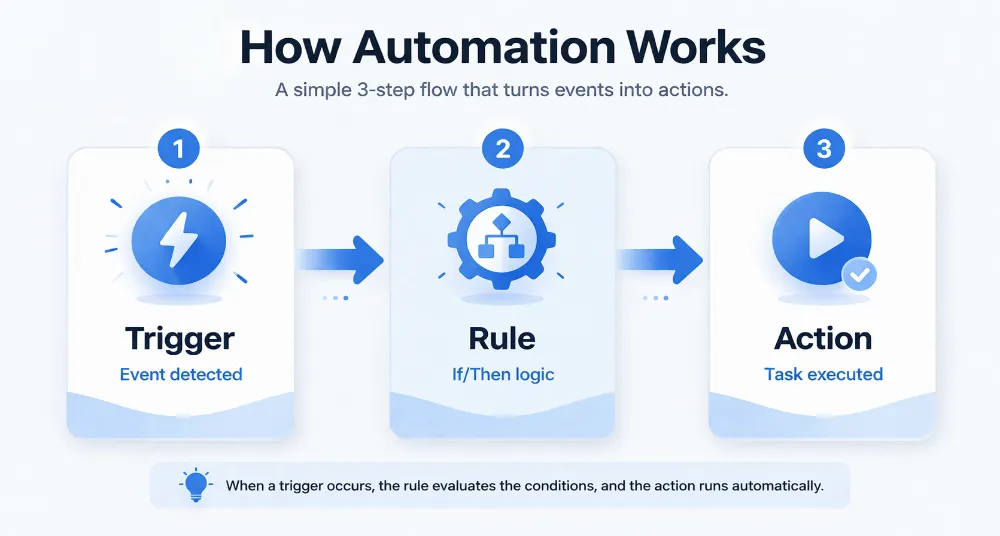
Automation typically follows a simple model: Input → Process → Output. The system receives data (input), applies predefined rules (process), and produces a result (output).
This structured approach ensures consistency and reduces manual effort. For example, in email scheduling, a user sets a time (input), the system processes the request based on its rules, and the email is sent automatically at the scheduled time (output). It’s important to note that automation does not have decision-making ability. It strictly executes instructions and cannot adapt, learn, or make decisions beyond its programmed logic.
Common Examples of Automation
You encounter automation in many everyday systems. Email scheduling tools automatically send messages at set times without manual effort.
Payroll systems calculate salaries, deductions, and payments based on predefined rules. Basic chatbots respond to common queries using scripted responses, while data entry systems transfer and organize information without human intervention.
These examples show how automation simplifies routine tasks and improves efficiency across different industries.
Agentic AI is a type of artificial intelligence where autonomous agents pursue goals, make decisions, and take actions with minimal human intervention.
What is agentic AI?
Definition of Agentic AI
Agentic AI refers to systems built as autonomous agents that operate independently to achieve specific goals. Unlike static systems, these agents are goal-driven, meaning they focus on outcomes rather than just executing fixed instructions.
They can analyze situations, make decisions, and take actions on their own, allowing them to handle dynamic and complex tasks more efficiently.
How Agentic AI Works
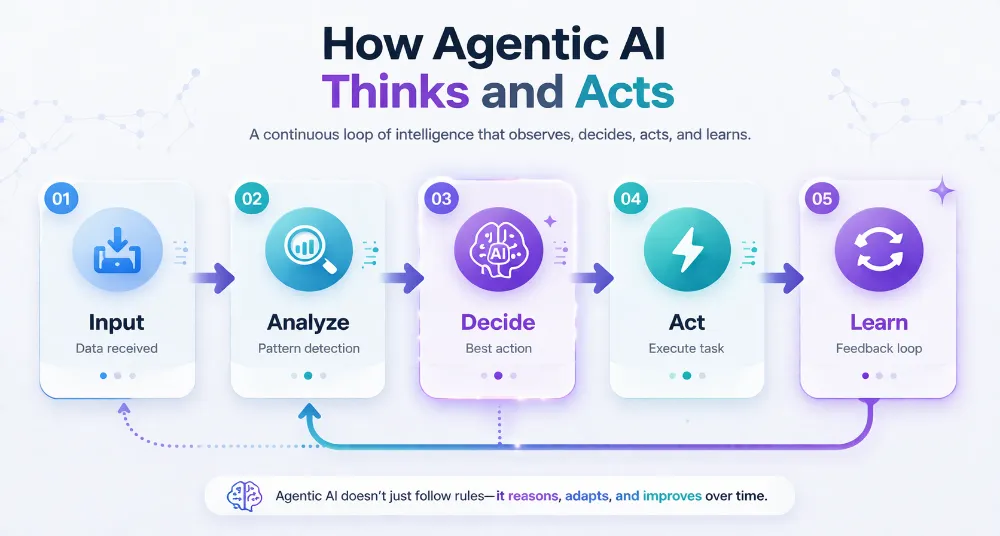
To understand how agentic AI functions in real-world scenarios, it operates through a continuous loop: Perception → Planning → Action → Learning.
Perception involves gathering information from data or the environment.
Planning determines the best steps to achieve a goal.
Action executes those steps using available tools.
Learning improves future performance based on outcomes.
These systems use memory to store past interactions, reasoning to make informed decisions, and external tools like APIs or web search—for example, an agent might query a database to retrieve updated information.
They can also adapt dynamically as new data becomes available. For instance, an AI research assistant gathers information (perception), creates a research plan (planning), retrieves data from sources (action), and refines results based on feedback (learning).
Examples of Agentic AI
Agentic AI is already being used in several real-world applications. AI research assistants can gather, analyze, and summarize information with minimal input.
Autonomous trading bots monitor markets and execute trades based on evolving conditions. AI customer support agents handle queries, resolve issues, and improve responses over time. AI coding assistants can generate, debug, and refine code based on user goals.
In short, agentic AI enables systems to think, act, and continuously improve to achieve defined goals.
Automation vs Agentic AI: Key Differences
Understanding automation vs agentic AI is essential to see how modern systems move from fixed execution to intelligent decision-making.
Side-by-Side Comparison Table between Automation vs Agentic AI
| Feature | Automation | Agentic AI |
| Logic | Rule-based | Goal-driven |
| Decision-making | ❌ No | ✅ Yes |
| Learning ability | ❌ No | ✅ Yes |
| Flexibility | Low | High |
| Human intervention | Required | Minimal |
| Example | Data entry bot | AI assistant |
Core Difference Explained
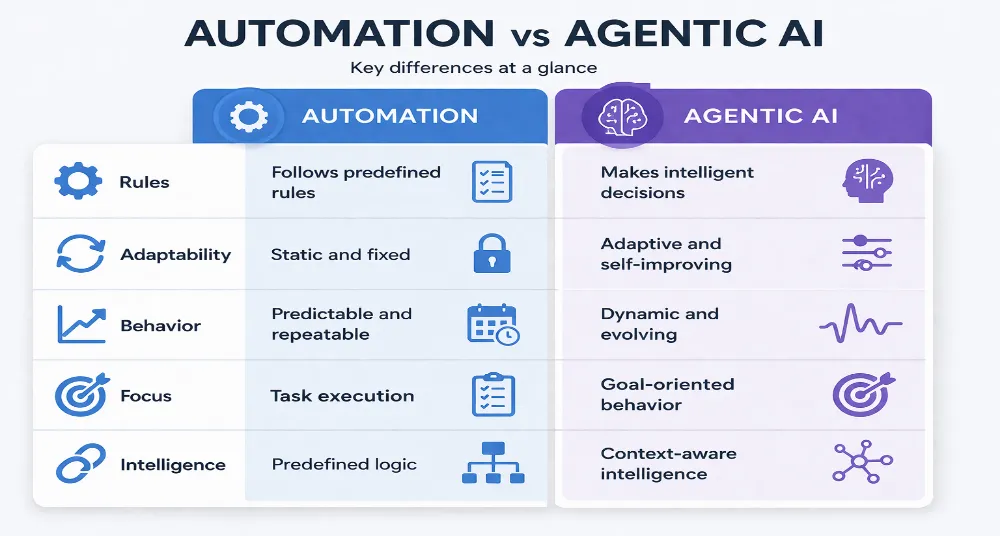
Automation executes predefined tasks, while agentic AI thinks, decides, and executes.
In simple terms, automation follows fixed instructions to complete repetitive tasks, making it reliable but limited. In contrast, agentic AI operates with goals, allowing it to make decisions, adapt to new information, and handle more complex, dynamic scenarios. This is the key difference between automation and agentic AI.
Real Example: Automation vs Agentic AI
Automation:
- Sends emails at scheduled times
Agentic AI:
- Analyzes user behavior
- Chooses optimal timing
- Personalizes content
- Sends emails automatically
This shows that automation performs tasks exactly as instructed, while agentic AI improves outcomes by adapting its actions based on data and context. This highlights how agentic AI optimizes outcomes, not just execution.
A common mistake I’ve noticed is assuming automation can handle complex decision-making. In reality, rule-based systems often break down when workflows become dynamic or unpredictable.
In short, automation follows rules, while agentic AI intelligently decides how to achieve the best result.
Real-World Use Cases of Automation and Agentic AI
Both automation use cases and agentic AI use cases power real-world AI applications across industries, but they differ in execution and decision-making.
Automation Use Cases
Manufacturing workflows: Automation runs assembly lines using predefined rules, ensuring consistent output, fewer errors, and continuous production without manual intervention.
Invoice processing: Automation extracts invoice data, validates fields, and processes payments using fixed rules, reducing manual entry and standardizing financial operations.
Social media scheduling: Automation posts content at preset times, ensuring consistent publishing without analyzing audience behavior or adjusting timing dynamically.
CRM updates: Automation logs interactions, updates records, and triggers follow-ups based on predefined workflows, maintaining structured and consistent data management.
In practical scenarios, automation works best when processes are stable and repetitive. Many small teams achieve significant efficiency gains just by automating routine operations before moving to more advanced AI systems.
Agentic AI Use Cases
AI-powered business operations: Agentic AI monitors workflows, identifies bottlenecks, and autonomously adjusts processes to achieve business goals and improve outcomes.
Autonomous marketing systems: Agentic AI analyzes user behavior, selects optimal channels, personalizes campaigns, and continuously adapts strategies to maximize engagement.
AI trading systems: Agentic AI evaluates market data, detects patterns, and dynamically executes trades based on evolving conditions and defined profit or risk goals.
AI-powered SaaS assistants: Agentic AI understands user intent, automates multi-step tasks, and adapts responses based on context and behavior.
These examples show how automation use cases focus on consistent execution, while agentic AI use cases highlight adaptive, goal-driven systems that actively optimize outcomes in dynamic environments.
As workflows become more complex, agentic AI starts delivering more value by handling multi-step decisions. This is especially useful in areas like trading, customer support, and dynamic content generation.
Benefits and Limitations
Understanding the benefits of automation and limitations of agentic AI helps businesses choose the right technology for scalable operations.
Benefits of Automation
Cost reduction: Automation reduces labor costs by handling repetitive tasks like data entry, lowering operational expenses, and improving resource allocation over time.
Efficiency: Automation accelerates workflows by executing predefined tasks instantly, reducing turnaround time in processes like order processing and reporting.
Consistency: Automation ensures standardized outputs by following fixed rules, minimizing variability in tasks such as manufacturing, billing, and compliance reporting.
Limitations of Automation
No adaptability: Automation cannot adjust to changing conditions, requiring manual reconfiguration when workflows or business rules change unexpectedly.
Fails with unexpected inputs: Automation breaks when encountering unstructured or incorrect data, often causing errors, delays, or manual intervention.
Benefits of Agentic AI
Adaptive decision-making: Agentic AI evaluates real-time data, adjusts strategies dynamically, and makes informed decisions aligned with business goals.
Handles complex workflows: Agentic AI manages multi-step processes across systems, coordinating tasks like customer support, analytics, and operations without rigid rules.
Continuous learning: Agentic AI improves over time by learning from data and feedback, enhancing accuracy and decision quality in evolving scenarios.
Limitations of Agentic AI
Higher implementation cost: Agentic AI requires investment in infrastructure, data pipelines, and model training, increasing upfront costs compared to traditional automation.
Risk of incorrect decisions: Agentic AI may produce inaccurate outcomes if trained on poor data or misaligned goals, impacting performance and trust.
Needs monitoring and control: Agentic AI requires ongoing oversight to ensure reliability, prevent unintended actions, and maintain alignment with business objectives.
These trade-offs show how automation suits stable tasks, while agentic AI enables adaptive, goal-driven decision-making in complex and rapidly changing environments.
Tools enable businesses to deploy automation tools and agentic AI tools to streamline workflows and execute intelligent, goal-driven operations.
Popular Automation Tools 2026
Zapier: Connects apps and triggers actions based on predefined rules, commonly used for email automation, CRM updates, and simple cross-platform workflow execution.
n8n: Open-source automation tool that supports custom integrations and conditional logic, ideal for developers building flexible, self-hosted automation systems.
Make (Integromat): A Visual platform for designing multi-step workflows with advanced logic, widely used for complex data processing, API orchestration, and scalable task automation.
To understand which platforms fit your needs, explore my detailed guide on the top automation tools in 2026for beginners, covering tools like Zapier, n8n, and Make.
Popular Agentic AI Tools 2026
LangChain: Framework for building agentic AI systems that combine LLMs, tools, and memory, enabling multi-step reasoning and context-aware decision-making.
AutoGen: A Multi-agent system by Microsoft that enables autonomous collaboration between AI agents, allowing dynamic task delegation and complex problem-solving workflows.
OpenAI Agents: Platform for creating intelligent agents that plan, use tools, and execute tasks autonomously, supporting adaptive decision-making and real-time workflow execution.
The choice of tools highlights the evolution from rule-based automation to adaptive, decision-driven agentic AI systems.
The Future of Work in 2026
The future of work 2026 is shaped by automation and agentic AI, transforming tasks into intelligent, autonomous workflows.
Rise of AI Agents
Businesses are deploying AI agents across customer service, analytics, and operations, reducing manual effort while improving speed, scalability, and decision accuracy.
Traditional automation is evolving into agentic AI, enabling systems to plan, decide, and act autonomously, shifting from static workflows to adaptive, outcome-driven operations.
Jobs That Will Be Impacted
Customer support: Routine queries are handled by AI agents, leading to partial automation while humans focus on complex, high-value customer interactions.
Data entry: Repetitive data processing tasks are fully automated using AI systems, significantly reducing manual roles while improving accuracy and operational efficiency.
Marketing operations: Campaign execution, reporting, and testing are automated, allowing marketers to focus on strategy, creativity, and audience insights.
Finance tasks: Invoice processing, reconciliation, and reporting are automated, with AI augmenting analysts in decision-making and risk assessment.
New Roles Emerging
AI agent manager: Oversees deployment and optimization of agentic AI systems, ensuring alignment with business goals while managing performance, risks, and outcomes.
Prompt engineer: Designs and refines inputs for AI systems, improving output quality and enabling reliable decision-making in complex workflows.
AI workflow designer: Builds intelligent workflows combining automation and AI agents, ensuring seamless integration, scalability, and operational efficiency.
Human + AI Collaboration
Humans focus on strategy, creativity, and oversight, while AI agents handle execution, resulting in faster operations and improved organizational agility.
AI manages repetitive tasks and optimization, enabling humans to concentrate on innovation and complex problem-solving, driving higher productivity and better outcomes.
Human and AI collaboration will define a more efficient, adaptive, and intelligent workplace in the years ahead.
Automation vs Agentic AI: Which One Should You Choose?
Choosing between automation vs agentic AI depends on whether your workflows are rule-based or require adaptive decision-making.
When to Use Automation
Use automation for repetitive, rule-based tasks like invoice processing or CRM updates, where predefined triggers ensure speed, consistency, and reduced operational errors.
Ideal for high-volume processes with predictable inputs, such as email scheduling or data syncing, delivering efficiency gains and lower costs through standardized execution.
When to Use Agentic AI
Use agentic AI for complex workflows like customer support escalation or market analysis, where systems must interpret context, make decisions, and adapt dynamically.
Best for multi-step tasks involving uncertainty, such as AI-driven trading or campaign optimization, improving outcomes through continuous reasoning and real-time adjustments.
Hybrid Approach (Best Strategy)
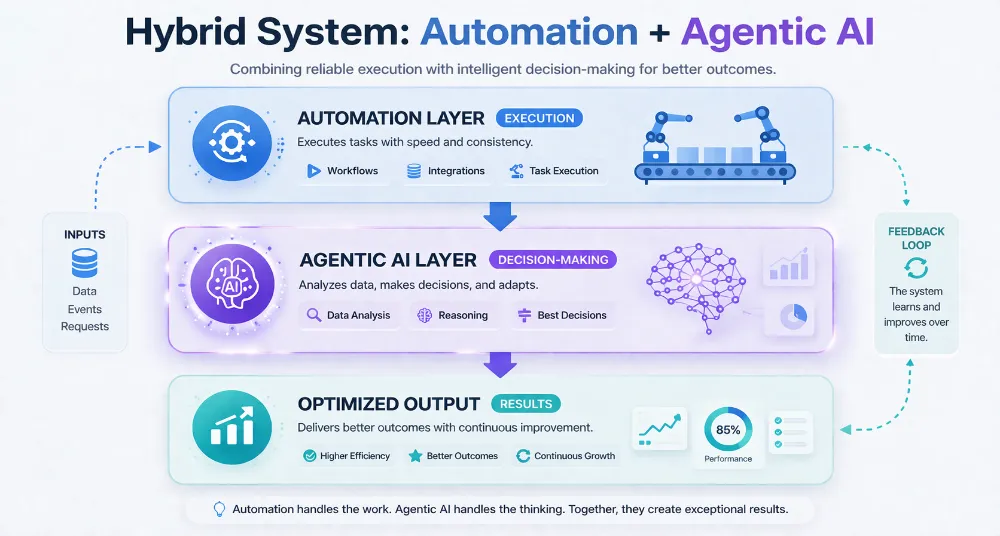
Combine automation for structured tasks with agentic AI for decision layers, enabling scalable systems like automated pipelines enhanced with intelligent exception handling.
Hybrid systems maximize efficiency and intelligence by reducing manual effort while improving adaptability, leading to better performance, cost optimization, and smarter business operations.
The best choice depends on task complexity, required intelligence, and how effectively businesses combine both approaches for optimal results.
In the automation vs agentic AI landscape, the difference is straightforward: automation delivers efficiency through fixed rules, while agentic AI enables adaptive, context-aware decision-making. Each plays a distinct role, but together they shape modern systems by combining consistency with intelligent, real-time responsiveness.
As the future of work evolves, the shift from automation → autonomy is becoming a strategic necessity. Businesses that embrace this change can build smarter workflows, adapt faster to market shifts, and achieve sustained competitive advantage through systems that continuously learn and optimize outcomes.
The real opportunity isn’t choosing between automation and agentic AI, but combining both. Systems that automate execution while using AI for decision-making tend to perform better and scale more efficiently.
In my view, businesses that start experimenting with agentic AI today will be better positioned as decision-driven systems become the standard.
👉 “Automation reduces effort, but agentic AI transforms decision-making itself.”
FAQs
What is the difference between automation and agentic AI?
Automation executes predefined rules, while agentic AI makes decisions and adapts to changing conditions. The key difference lies in flexibility—automation handles predictable, repetitive tasks, whereas agentic AI manages dynamic workflows that require reasoning, context awareness, and multi-step problem-solving.
Is agentic AI better than automation?
Agentic AI is not inherently better than automation; it is better suited for complex, decision-driven tasks. Automation remains more efficient for structured, rule-based processes, while agentic AI adds value in scenarios requiring adaptability, making the right choice dependent on workflow complexity and business goals.
Can agentic AI replace jobs?
Agentic AI can automate tasks, but it is more likely to reshape jobs than fully replace them. The impact of AI on jobs includes reducing manual work while increasing demand for roles focused on oversight, strategy, and AI collaboration, leading to workforce transformation rather than elimination. In practice, most businesses don’t fully replace roles—they redesign them, using AI to handle tasks while humans focus on strategy and oversight.
Is automation still relevant in 2026?
Automation remains essential in 2026 for handling high-volume, repetitive processes efficiently. Businesses rely on it for tasks like data entry, reporting, and workflow execution, where speed and consistency are critical, ensuring its continued relevance alongside more advanced AI systems.
What is RPA vs agentic AI?
RPA (Robotic Process Automation) is a subset of automation that mimics human actions in structured, rule-based digital tasks, while agentic AI enables decision-making. RPA operates through user interfaces and predefined workflows, whereas agentic AI handles unstructured problems requiring reasoning and adaptability.
Can small businesses use agentic AI?
Yes, small businesses can adopt agentic AI using affordable, cloud-based tools. AI for small businesses enables smarter decision-making, faster response times, and personalized customer interactions, helping smaller teams scale operations efficiently without requiring large technical resources.